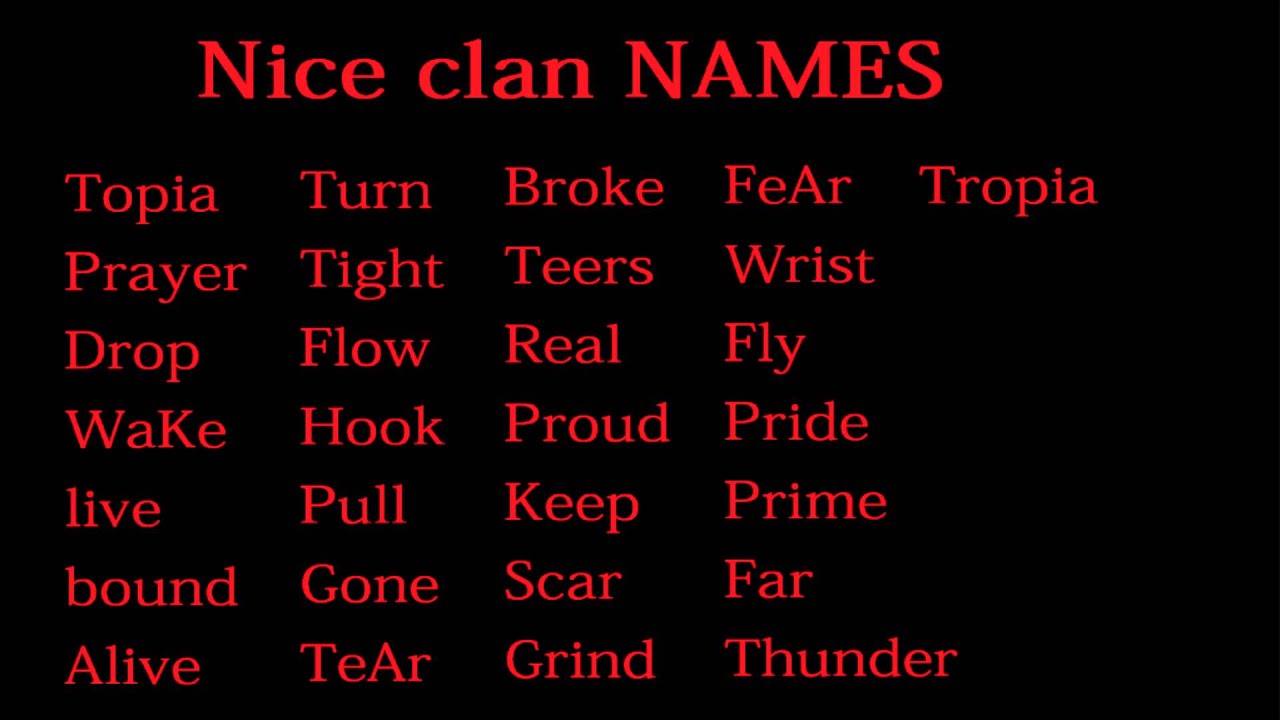
What is a clan name? A clan name is a name that is shared by all members of a clan. It is typically passed down from generation to generation, and it can be used to identify the clan's members and their shared heritage.
Clan names can be based on a variety of factors, including the clan's geographical location, the clan's occupation, or the clan's founder. For example, the clan name "MacDonald" is derived from the Gaelic words "Mac" (son of) and "Donald" (ruler of the world). This suggests that the clan MacDonald is descended from a man named Donald who was a ruler or chieftain.
Clan names are important because they provide a sense of identity and belonging for clan members. They can also be used to trace the clan's history and to connect with other members of the clan. In some cultures, clan names are also used to determine a person's social status and to regulate marriage and other social customs.
Clan names have been used for centuries, and they continue to be an important part of many cultures around the world. They are a reminder of our shared heritage and a way to connect with our ancestors and our community.
Clan Names
Clan names are an important part of many cultures around the world. They provide a sense of identity and belonging for clan members, and can also be used to trace the clan's history and to connect with other members of the clan.
- Identity: Clan names can help to identify the clan's members and their shared heritage.
- History: Clan names can be used to trace the clan's history and to learn about the clan's ancestors.
- Culture: Clan names are often associated with a particular culture or region.
- Social status: In some cultures, clan names can be used to determine a person's social status.
- Marriage: Clan names can also be used to regulate marriage and other social customs.
Clan names are a complex and fascinating part of many cultures around the world. They can tell us about a clan's history, culture, and social structure. Clan names can also be a source of pride and identity for clan members.
Identity
Clan names are an important part of many cultures around the world. They provide a sense of identity and belonging for clan members, and can also be used to trace the clan's history and to connect with other members of the clan.
One of the most important functions of clan names is to identify the clan's members and their shared heritage. Clan names can be used to distinguish between different clans, and they can also be used to trace the clan's history and to learn about the clan's ancestors. In some cultures, clan names are also used to determine a person's social status and to regulate marriage and other social customs.
For example, in Scotland, clan names are often used to identify a person's clan and their family history. Clan names can also be used to trace the clan's history and to learn about the clan's ancestors. In some cases, clan names can also be used to determine a person's social status and to regulate marriage and other social customs.
Clan names are an important part of many cultures around the world. They provide a sense of identity and belonging for clan members, and can also be used to trace the clan's history and to connect with other members of the clan. Clan names are also an important part of many legal and administrative systems, and they can be used to identify individuals and to determine their rights and responsibilities.
History
Clan names are an important part of many cultures around the world. They provide a sense of identity and belonging for clan members, and can also be used to trace the clan's history and to connect with other members of the clan. One of the most important functions of clan names is to identify the clan's members and their shared heritage. Clan names can be used to distinguish between different clans, and they can also be used to trace the clan's history and to learn about the clan's ancestors.
- Facet 1: Historical Records
Clan names can be found in a variety of historical records, including birth certificates, marriage certificates, and death certificates. These records can provide valuable information about the clan's history and the clan's ancestors. For example, a birth certificate may list the names of the child's parents and grandparents, which can help to trace the child's lineage.
- Facet 2: Oral Histories
Clan names are also often passed down through oral histories. These stories can provide valuable information about the clan's history and the clan's ancestors. For example, an oral history may tell the story of how the clan was founded, or it may describe the clan's migration from one place to another.
- Facet 3: Clan Crests and Tartans
Clan names are often associated with clan crests and tartans. These symbols can provide valuable information about the clan's history and the clan's ancestors. For example, a clan crest may depict the clan's founder or a significant event in the clan's history.
- Facet 4: DNA Testing
DNA testing can also be used to trace the clan's history and to learn about the clan's ancestors. DNA testing can identify genetic markers that are shared by all members of the clan. This information can be used to create a genetic map of the clan and to trace the clan's migration from one place to another.
Clan names are an important part of many cultures around the world. They provide a sense of identity and belonging for clan members, and can also be used to trace the clan's history and to connect with other members of the clan. The study of clan names can provide valuable insights into the history of a clan and the history of a region.
Culture
Clan names are often associated with a particular culture or region because they can provide a sense of identity and belonging for clan members. They can also be used to trace the clan's history and to connect with other members of the clan. In some cultures, clan names are also used to determine a person's social status and to regulate marriage and other social customs.
For example, in Scotland, clan names are often used to identify a person's clan and their family history. Clan names can also be used to trace the clan's history and to learn about the clan's ancestors. In some cases, clan names can also be used to determine a person's social status and to regulate marriage and other social customs.
Clan names are an important part of many cultures around the world. They provide a sense of identity and belonging for clan members, and can also be used to trace the clan's history and to connect with other members of the clan. The study of clan names can provide valuable insights into the history of a clan and the history of a region.
Social status
Clan names are often associated with a particular culture or region, and they can be used to identify the clan's members and their shared heritage. In some cultures, clan names are also used to determine a person's social status.
- Facet 1: Aristocratic Clans
In some cultures, certain clan names are associated with aristocratic families. For example, in Scotland, the clan name "Campbell" is associated with the Duke of Argyll, who is one of the most powerful and influential in the country.
- Facet 2: Commoner Clans
In some cultures, certain clan names are associated with commoner families. For example, in Japan, the clan name "Suzuki" is one of the most common surnames in the country.
- Facet 3: Occupational Clans
In some cultures, certain clan names are associated with particular occupations. For example, in Ireland, the clan name "O'Brien" is associated with the occupation of blacksmith.
- Facet 4: Religious Clans
In some cultures, certain clan names are associated with particular religions. For example, in India, the clan name "Sharma" is associated with the Hindu religion.
The use of clan names to determine a person's social status is a complex and fascinating topic. It is important to remember that the relationship between clan names and social status can vary from culture to culture. However, the study of clan names can provide valuable insights into the history and social structure of a particular culture.
Marriage
Clan names are often used to identify the clan's members and their shared heritage. In some cultures, clan names are also used to regulate marriage and other social customs.
- Title of Facet 1: Clan Exogamy
Clan exogamy is the practice of marrying outside of one's own clan. This practice is common in many cultures around the world, and it is often used to prevent incest and to promote social cohesion.
- Title of Facet 2: Clan Endogamy
Clan endogamy is the practice of marrying within one's own clan. This practice is less common than clan exogamy, but it is still found in some cultures around the world. Clan endogamy can be used to preserve the clan's genetic identity and to maintain social control.
- Title of Facet 3: Marriage Alliances
Marriage alliances are often used to create political and economic alliances between different clans. These alliances can be used to secure access to resources, to gain political power, or to protect the clan from attack.
- Title of Facet 4: Bride Price
Bride price is the practice of paying a sum of money or goods to the family of the bride. This practice is common in many cultures around the world, and it is often seen as a way to compensate the bride's family for the loss of her labor.
The use of clan names to regulate marriage and other social customs is a complex and fascinating topic. It is important to remember that the relationship between clan names and marriage customs can vary from culture to culture. However, the study of clan names can provide valuable insights into the history and social structure of a particular culture.
Clan Name FAQs
This section provides answers to frequently asked questions about clan names. These questions and answers provide a concise overview of the topic and address common misconceptions.
Question 1: What is a clan name?
A clan name is a name that is shared by all members of a clan. It is typically passed down from generation to generation and can be used to identify the clan's members and their shared heritage.
Question 2: What is the purpose of a clan name?
Clan names serve several purposes. They can be used to identify the clan's members, trace the clan's history, and connect with other members of the clan. In some cultures, clan names are also used to determine a person's social status and to regulate marriage and other social customs.
Question 3: How are clan names chosen?
Clan names can be based on a variety of factors, including the clan's geographical location, the clan's occupation, or the clan's founder. For example, the clan name "MacDonald" is derived from the Gaelic words "Mac" (son of) and "Donald" (ruler of the world). This suggests that the clan MacDonald is descended from a man named Donald who was a ruler or chieftain.
Question 4: Are clan names always passed down from father to son?
No, clan names are not always passed down from father to son. In some cultures, clan names are passed down through the female line. For example, in the Iroquois Confederacy, clan names are passed down from the mother to her children.
Question 5: Can people change their clan name?
In some cultures, people are allowed to change their clan name. This may be done for a variety of reasons, such as adoption or marriage. However, in other cultures, clan names are considered to be permanent and cannot be changed.
Question 6: What is the difference between a clan name and a surname?
A clan name is a name that is shared by all members of a clan, while a surname is a name that is shared by all members of a family. Clan names are typically passed down from generation to generation, while surnames are often adopted by new members of a family.
We hope this FAQ section has been helpful in answering your questions about clan names. If you have any further questions, please feel free to contact us.
Transition to the next article section: Clan names are a fascinating and complex topic. They can tell us a lot about a clan's history, culture, and social structure. The study of clan names can be a rewarding experience, and we encourage you to learn more about this topic.
Conclusion
This article has explored the topic of clan names, their importance, and their usage around the world. We have seen that clan names can serve a variety of purposes, from identifying clan members to regulating marriage and other social customs.
Clan names are a fascinating and complex topic. They can tell us a lot about a clan's history, culture, and social structure. The study of clan names can be a rewarding experience, and we encourage you to learn more about this topic.
Best Young Hollywood: Top Actors In Their 20s
All About Keidis Helena: Biography, News, And Fun Facts
The Rise Of Fat Black Celebrities: Embracing Inclusivity And Empowerment